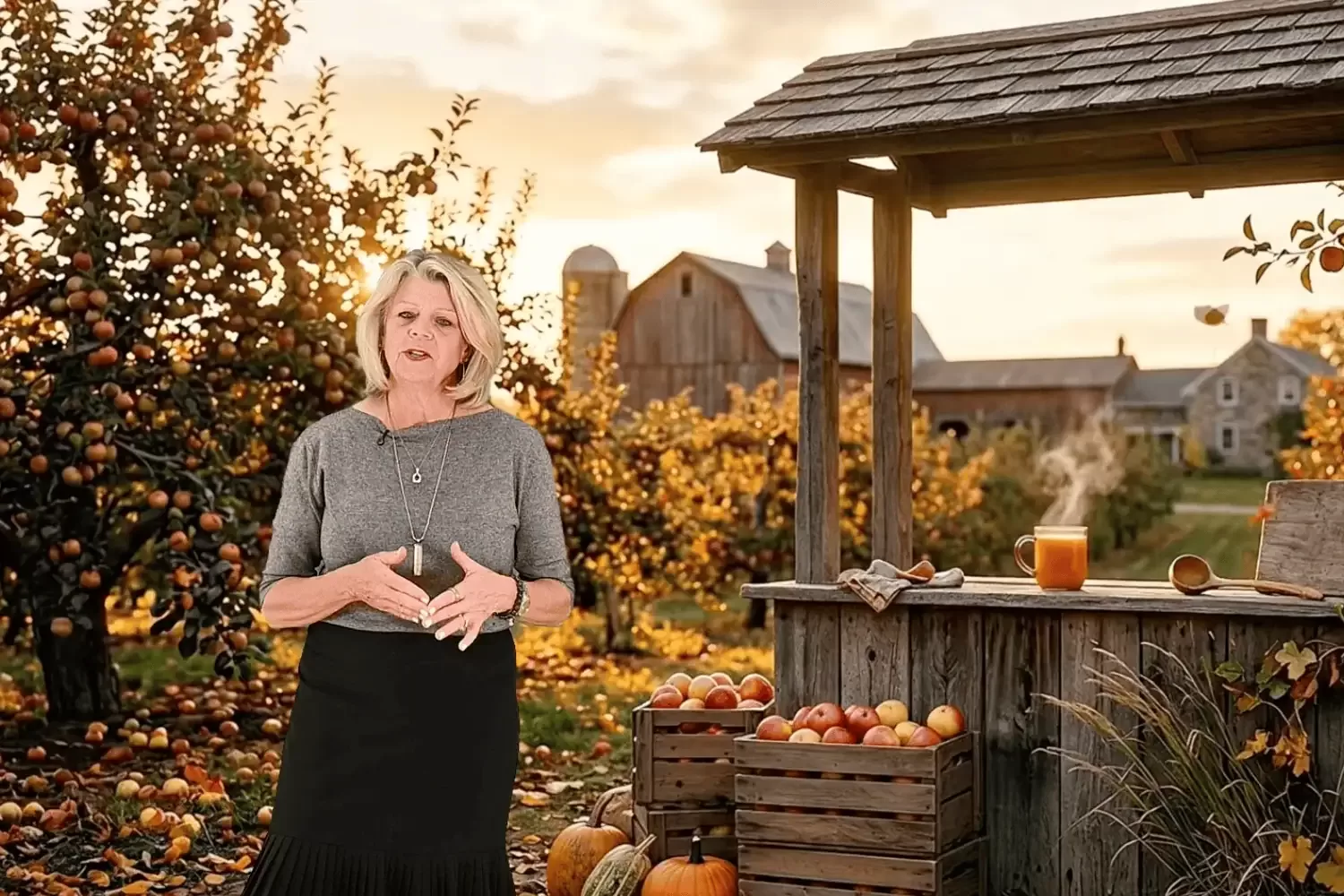
Most people think of fall in Maine as leaf season. The color is spectacular, the landscape changes almost overnight, and for a few weeks, it seems as though everyone is looking up.
But there is another version of fall happening at the same time.
It involves apples, old farms, forgotten orchards, and a man who has spent more than 50 years searching for apple varieties that nearly disappeared. His name is John Bunker, and his work offers an interesting way to think about Maine—not just its history, but the land and properties that are still part of that history.
Why were there so many different kinds of apples in Maine?
Apples have been grown in Maine since the first European settlers arrived. By the 1800s, orchards were common on Maine farms, with hundreds of varieties grown for eating, baking, drying, storing, and making cider.
Many of those apples were closely connected to a particular farm or region. Some may have been grown by only a handful of families.
That makes sense when you think about how people lived at the time. A farm wasn’t simply a house with a few acres around it. The land had to provide much of what a family needed. An apple that stored well through the winter was useful. Another might have been particularly good for cider or baking.
So when you look at an old Maine property today, the land may tell you something the house can’t.
An unusual collection of mature fruit trees might suggest an old orchard. A stone wall disappearing into the woods might mark an earlier boundary. A level clearing could have once been a pasture or a farm field.
You begin to realize that the property you are looking at may have had a very different life before the current house was built.
What happened to all those old Maine apples?
Many simply disappeared. As farming changed and commercial agriculture became more concentrated, there was less reason to maintain dozens—or hundreds—of local apple varieties. Old orchards disappeared. Farms were divided or abandoned. Trees died.
But some varieties survived in unexpected places: an old backyard, a forgotten corner of a farm, or a single tree that someone had continued to care for without necessarily realizing how unusual it was.
And that raises another question: How do you find an apple that almost nobody remembers anymore?
Who is John Bunker, and what does an apple detective actually do?
John Bunker first came to Maine in 1962. He was eleven years old. More than 60 years later, he is one of the country’s foremost experts on old apples. He has spent decades looking for varieties that were once common in Maine but have nearly disappeared.
His clues aren’t necessarily maps or records. They can be old orchards, forgotten trees, stories from farmers, or even an apple brought to him by someone who remembers it from childhood.
In the 1970s, Bunker was managing a co-op store in Belfast when a man brought in a few bushels of an apple he had never seen before. It was dark, almost purple.
It was the Black Oxford.
The variety could be traced back to a tree found in Oxford County around 1790. That is where Bunker’s work becomes particularly interesting—and where it starts to feel surprisingly relevant to real estate. Because finding an old apple isn’t simply about identifying a fruit. It is about understanding the clues that tell you where something came from.
How do you preserve an apple variety that is almost lost?
You can’t simply plant the seed from an old apple and expect to grow the same variety. Apple seeds don’t reproduce a variety reliably. To preserve an old variety, you take a cutting from the original tree and graft it onto new rootstock.
So Bunker learned to graft. And for decades, he has continued looking for the apples that Maine almost lost. There is something familiar about that process when you think about older Maine properties. A property often has clues, too. The challenge isn’t necessarily seeing them. It’s knowing what they mean.
What can an old apple tree tell you about a property?
Quite a lot. An old apple tree can be a clue to the history of the land.
It might tell you that an orchard once stood there. It might suggest that the property was once part of a larger farm. It might simply be evidence that someone planted and cared for that tree generations ago. There is a Black Oxford tree in Hallowell that is more than 200 years old and still bearing fruit. It was planted when the property was a farm, long before the way the land looks today.
Think about that for a moment.
The house may have changed. The people who lived there have changed. The property may have changed hands several times.
But the tree is still there. And that is one of the fascinating things about looking at real estate in Maine. Sometimes the most interesting things about a property aren’t the things that appear in the listing.
What else can the land tell you that the listing doesn’t?
A lot of Maine’s history is written into the landscape. A stone wall can tell you something about an earlier use of the land. An old foundation can suggest that a building once stood somewhere different from where the current house sits. Mature trees can reveal an old homestead, orchard, or planned landscape.
Even the shape of the land can provide clues. Why is the driveway where it is? Why does the lawn open up in one particular direction? Why does a stone wall disappear into the woods? None of those things necessarily changes the number of bedrooms or the square footage.
But they can change how you understand the property. And that matters when you’re buying a home in Maine because you’re not just buying a structure. You’re buying a piece of land with a history that usually extends much further back than the house itself.
Why does that kind of local knowledge matter in real estate?
A listing can tell you the facts. The square footage. The acreage. The number of bedrooms and bathrooms. The age of the house. All of those things matter. But they don’t always tell you the story.
Understanding a property can sometimes require looking a little deeper and asking a few more questions.
- Was this once a farm?
- What was here before the house?
- Why are those stone walls there?
- Are those trees simply mature landscaping—or are they remnants of something older?
- And is that old apple tree in the backyard just an apple tree?
Maybe. Or maybe it is a small piece of Maine history that has been quietly growing there for generations.
John Bunker has spent much of his life learning to recognize those kinds of clues. His work is a reminder that interesting stories aren’t always obvious at first glance.
The same can be true when you’re looking at a home. You’re not just looking at the house. You’re looking at the land, the trees, the stone walls, the neighborhood—and sometimes an old apple tree that has been there longer than anyone can remember.
Some Maine history grows on trees.
Sometimes you just have to know what to look for.
Moving to Maine?
About the Author: Michael